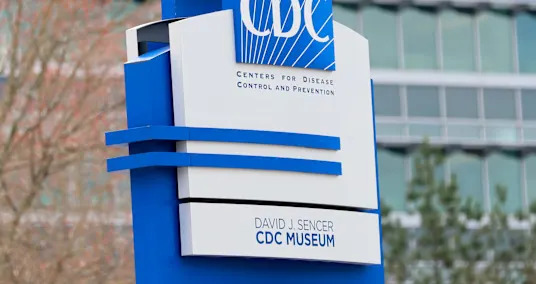
NEW YORK (AP) — The federal government's disease-tracking agency has paused its diagnostic testing for rabies, monkeypox and a number of other infectious diseases.
The Centers for Disease Control and Prevention this week posted a list of more than two dozen types of testing that have become unavailable.
This is not the first time the CDC has paused some of its lab testing. But it is pausing more kinds of tests than ever before, and it is not totally clear why, said Scott Becker, chief executive officer of the Association of Public Health Laboratories.
A government spokesman called the pause temporary and attributed it to “a routine review to uphold our commitment to high quality laboratory testing.”
“We anticipate some of these tests will be available through CDC labs again in the coming weeks. In the meantime, CDC stands ready to support our state and local partners to access the public health testing they need,” said Andrew Nixon of the U.S. Department of Health and Human Services, which oversees the CDC.
CDC's laboratory operations were faulted during the COVID-19 pandemic, and they were the subject of a subsequent work group's review. The agency has been evaluating its testing since 2024, Becker said.
But there can be other reasons for taking tests offline, including staffing issues, he noted.
The pausing of lab testing comes in the wake of the dramatic downsizing of the CDC in the last year through layoffs, retirements, resignations and the nonrenewal of temporary appointments. Staffing fell by 20% to 25%, according to different estimates, and was felt across the agency — including in the laboratories.
The poxvirus and rabies labs lost about half their prior staff, and the CDC’s malaria branch was gutted even more, according to the National Public Health Coalition, an organization of former and current CDC workers that formed in the wake of the downsizing.
Some of the paused testing focuses on common infections for which commercial testing is available, like Epstein-Barr virus, and the varicella zoster virus behind chickenpox and shingles. But also on the list is testing for some more exotic agents, like the for parasitic worms responsible for “snail fever” and for the virus that causes “sloth fever.”
Some specialized state labs, like those in the New York and California, have the ability to pick up the slack while CDC tests are on pause, Becker said.
He called the pauses “concerning, only if it’s permanent."
___
The Associated Press Health and Science Department receives support from the Howard Hughes Medical Institute’s Science and Educational Media Group and the Robert Wood Johnson Foundation. The AP is solely responsible for all content.
LATEST POSTS
- 1
 'Stranger Things' series finale trailer shows Hawkins gang gearing up for last battle with Vecna
 - 2College students are now slightly less likely to experience severe depression, research shows – but the mental health crisis is far from over
- 3At least 490 protesters killed in Iran, activists say
- 4Venice’s newest marvel is a wild, acrobatic dolphin. His refusal to leave puts him in danger
- 5Brazil approves law strengthening protective measures for female victims of gender-based violence


- Finding the Universe of Workmanship: Individual Encounters in Imagination
- German gas price bill signed into law, but consumers not impressed
- Step by step instructions to Think about Disc Rates Across Various Banks
- The most exciting exoplanet discoveries of 2025
- Giant ‘toothed’ birds flew over Antarctica 40 million to 50 million years ago
- Kansas school officials report high student illness, dismiss early
- NASA Artemis 2 astronauts to make historic moon flyby today. Here's what to expect hour by hour (timeline)
- Germany's first Omani LNG shipments arrive despite Middle East disruptions
- Vinicultural Investigation: A Survey of \Enjoying Fine Vintages\ Wine sampling