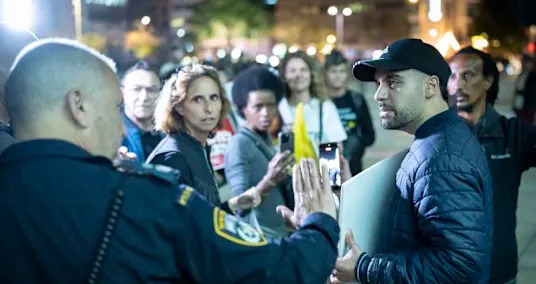
Protests took place in Tel Aviv, Jerusalem, Haifa, and Beersheba, as a survey found broad but uneven support among Jewish Israelis for Operation Roaring Lion.
Israel Police arrested 21 anti-war protesters Saturday night as demonstrations against the conflict with Iran expanded in multiple cities despite restrictions on public gatherings.
Protests took place in Tel Aviv, Jerusalem, Haifa, and Beersheba, with hundreds of participants reported in Tel Aviv and Jerusalem and about 100 in Haifa, marking the largest turnout since weekly demonstrations began. Authorities said 13 people were arrested in Tel Aviv and eight in Haifa.
Police said the gatherings were not approved under Home Front Command regulations that ban events with more than 50 people. Officials said the increase in turnout followed calls by groups opposing the government to protest despite the restrictions.
“During a situation assessment that took place at the scene with a Home Front Command representative… it was clarified that there was a real risk to human life and accordingly, Yarkon [precinct] police commander Tzachi Sharabi ordered the gathering to be dispersed,” police said.
Hadash-Ta’al chairman Ayman Odeh, an Arab lawmaker involved in the protests, criticized the police response, calling officers fascists “in the service of the government” and saying they were afraid of “the heroic citizens who went out, despite everything, to make their voice heard.”

Survey shows broad, uneven support for war
The demonstrations come as a March 2026 survey by the Israel Democracy Institute found broad but uneven support among Jewish Israelis for Operation Roaring Lion. Support was strongest on the Right at 87% and about half on the Left.
The survey also found that Jewish and Arab respondents largely agreed that Iran’s resilience has been stronger than expected. Most Jewish respondents said Israeli society could sustain the campaign for up to one month, while 28% said as long as needed. Arab respondents were less optimistic about how long the public could endure the conflict.
A majority of Jewish respondents said Prime Minister Benjamin Netanyahu’s decision was driven by security considerations, while most Arab respondents viewed it as political.
LATEST POSTS
- 1
 3 moms, 3 countries, 1 very familiar problem: Why child care costs still don't add up for families
 - 22024's Savvy Home Gadgets for an Associated Way of life
- 3The next frontier in space is closer than you think – welcome to the world of very low Earth orbit satellites
- 4Understanding Preschool Projects: Cultivating Abilities and Advancement
- 5Upgrading the Healthy benefit of Your Local Vegetables





- More people are addicted to marijuana, but fewer of them are seeking help, experts say
- This country music star spent years hiding his sexuality. Coming out — and beating addiction — has made his soul feel '20 pounds lighter.'
- Australians told to continue Easter travel plans despite fuel shortages
- If you want a true taste of Italian paradise, head to Favignana
- Remarkable Spots for Hot Air Swelling All over The Planet
- Creativity Revealed: A Survey of \Making Shocking Looks\ Cosmetics Item
- How to watch NASA's Artemis 2 astronauts launch to the moon on April 1
- Middle East hotels hit pandemic-era lows amid Iran war
- Become the best at Discussion: 6 Procedures for Progress