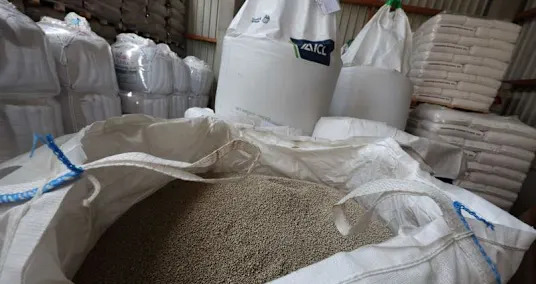

The war in Iran has resulted in a 30-40% spike in the cost of mineral fertilizer since the start of the year, threatening international food prices, according to German experts.
"World market prices for nitrogen fertilizer are increasingly approaching the peak levels we saw at the start of Russia's war against Ukraine [in February 2022]," said Philipp Spinne, managing director of the German Raiffeisen Association (DRV).
In Europe, however, consumers have not yet directly felt the effects because many farmers had already purchased their spring fertilizer before the Iran war began, the Bavarian Farmers' Association told dpa.
But should the war drag on, production costs in Germany and other countries are likely to rise, and with them, producer prices, it warned.
Four years ago, the threat to global food security feared by some experts did not materialize.
This was partly because Russia – a leading fertilizer producer – benefited from the invasion of its neighbour and actually increased its fertilizer exports.
The European Union has since gradually introduced tariff increases on Russian nitrogen fertilizers.
High energy prices are primarily driving the pricing spike, with gas prices accounting for up to 90% of the costs of ammonia and nitrogen production, said Germany's Agrar industry association.
Therefore, if gas becomes more expensive, fertilizer prices automatically rise. But if farmers use less fertilizer, crop yields suffer as a result.
LATEST POSTS
- 1
 Carrefour becomes first European retailer to offer shopping on ChatGPT
 - 2Avoid Slam: Exploring the Pickup Truck Transformation
- 3Woman shocked to welcome baby after experiencing stomach pain on Christmas
- 4You finally got a doctor's appointment. Here's how to get the most out of it
- 5We tasted one of the 10,000 Hershey's Dubai chocolate bars being resold on eBay. Is it worth the hype?



- Surveys of 6 Hot Savvy Beds
- Figure out How to Store Your Gold Ventures: A Thorough Aide safely
- Barry Manilow to have surgery for early-stage lung cancer and postpones January concerts
- Is new Harry Styles music on the way? Fans think so, after a cryptic website and posters pop up.
- What's your biological age? Experts explain the benefits and risks of at-home tests
- Instructions to Pick the Right Tires for Your Slam 1500.
- Forget 'Outer Banks.' These Gen Z-ers just want to watch 'M*A*S*H*' and 'Gilmore Girls.'
- A decade after Brazil’s deadly dam collapse, Indigenous peoples demand justice on the eve of COP30
- 4 Electric Vehicle Brands: Execution, Unwavering quality, and Development